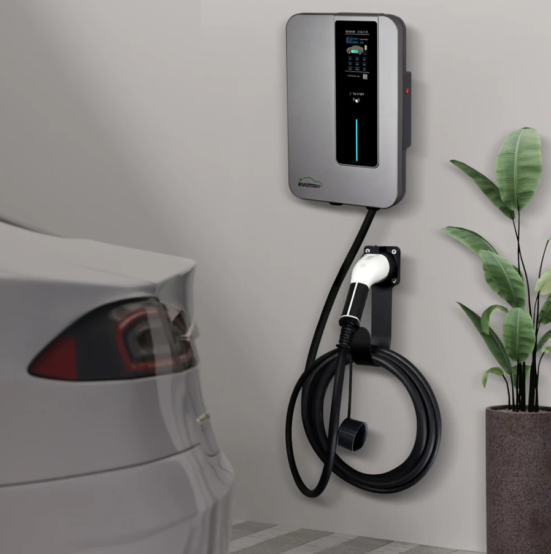
How to Choose a 7kW Home EV Charger — And the Right Electrician to Install It
Your car didn't come with a wall box. Here's exactly what to buy, what it costs, and the questions you must ask before an electrician touches your DB board.
You bought your EV. Congratulations. Then you got home, looked at the standard three-pin wall socket in your garage, and realised nobody told you the car doesn't actually come with a charger that goes on your wall.
This is the guide that fills that gap. We're going to explain exactly what a 7kW wall box is, why it's the right choice for most South African homes, what it costs, and — most importantly — how to choose a qualified electrician who won't leave you without a legal Certificate of Compliance.
⚡ Why you can't just use a regular wall plug
A standard South African wall socket delivers around 2 kW. That means a car with a 40 kWh battery would take 20+ hours to charge from empty. You'd also be drawing sustained current through a socket that wasn't designed for that — which is a fire risk over time.
A 7kW wall box — also called a wallbox, home charger, or EVSE — is a dedicated, hardwired charging unit. It connects directly to your distribution board (DB board) on its own circuit, delivers up to 7.4 kW safely and consistently, and typically charges most EVs in 4–8 hours overnight.
| Charger type | Power | Charge time (40 kWh battery) | Safe for daily use? |
|---|---|---|---|
| 🔌 Standard wall plug (3-pin) | ~2 kW | 20+ hours | ⚠️ Not recommended |
| 🔌 Portable EVSE (16A circuit) | 3.7 kW | ~11 hours | ✅ OK but slow |
| 🏠 7kW Wall box Recommended | 7.4 kW | ~5–6 hours | ✅ Yes — built for it |
| ⚡ 11 kW / 22 kW (3-phase) | 11–22 kW | 2–4 hours | ✅ If you have 3-phase supply |
🏠 Does your home support a 7kW charger?
About 70% of South African homes are on a single-phase supply — which is exactly what a 7kW charger needs. Most post-2000 homes can handle it without any upgrade to the main supply. Here's how to check.
💰 What does a 7kW charger cost in South Africa?
The honest answer is: it depends on three things — the charger you choose (basic vs smart), the complexity of your electrical setup, and where in South Africa you live. Here's the realistic breakdown.
Smart vs basic charger — is it worth paying more?
Yes, in most cases. A smart charger adds R2,000–R4,000 to the unit price, but it includes scheduled charging (you set it to charge at 11pm when rates are lower), app monitoring, and solar integration. The off-peak saving alone often pays for the smart charger within a year.
| Feature | Basic charger | Smart charger |
|---|---|---|
| Scheduled overnight charging | ❌ No | ✅ Yes — set via app |
| Solar PV integration | ❌ No | ✅ Yes |
| App monitoring & remote start/stop | ❌ No | ✅ Yes |
| Load balancing (won't trip DB board) | ❌ No | ✅ Yes |
| Typical SA price (unit only) | R4,000–R6,000 | R7,000–R12,000 Recommended |
🔧 Choosing the right electrician — this is where most people go wrong
This is the most important section of this entire guide. An EV charger is a permanent electrical installation. Under South Africa's Occupational Health and Safety Act and SANS 10142-1 (the national wiring code), the work must be done by a registered electrician who issues a valid Certificate of Compliance (CoC).
The 5 questions to ask every electrician before you hire them
- 1️⃣ Are you registered with the Department of Employment and Labour? Ask to see their wireman's licence card. There are three types: Single-Phase Tester, Installation Electrician, and Master Installation Electrician. For a standard 7kW home installation, an Installation Electrician is sufficient.
- 2️⃣ Will you issue a Certificate of Compliance (CoC) upon completion? This must be included in your quote as a line item, not an afterthought. If they hesitate or say "it's not necessary," walk away.
- 3️⃣ Will you do a site assessment first? A professional electrician will visit your property, inspect your DB board, measure the cable run distance, and confirm your supply type before quoting. If they quote without seeing your home, be cautious.
- 4️⃣ Is the quote fixed-price, or do extras appear on the day? A good installer gives you a fixed price that covers the charger, cable, conduit, dedicated breaker, earth-leakage protection (Type A or B RCD), and the CoC. Get it in writing.
- 5️⃣ What cable size will you use? For a 7kW charger, SANS 10142-1 requires at minimum 6mm² copper cable for runs up to 15m, and 10mm² for longer runs. If they can't tell you the cable spec, that's a problem.
What does a proper installation actually involve?
So you know what you're paying for, here's what a qualified electrician does during a standard 7kW installation:
Inspect DB board, check supply type, measure distance to parking bay, confirm earthing is adequate.
Add a dedicated 32A breaker and Type A/B RCD (earth-leakage protection) for the charger circuit. This is non-negotiable per SANS 10142 Annex N.
Run 6mm² or 10mm² copper cable from DB board to charger mounting point, in conduit where required.
Mount wall box to brick or concrete surface. Wire the unit, fit an earth spike if needed.
Test insulation resistance, earth-loop impedance, and RCD trip time. Issue Certificate of Compliance.
Power up charger, pair with app, run a test charge with your car. You sign off. Done — typically in 4–8 hours.
📊 Will it actually pay off? Let's run the numbers
Let's say you spend R14,000 on a 7kW smart wall box installed. Is it worth it? Here's the maths for someone driving 1,200 km per month (a typical South African figure).
That's a R14,000 installation paying for itself in under 2 years, then saving you R621 every month after that compared to relying on public charging. For drivers doing 1,800 km/month, the payback is closer to 14 months.
⚡ What about load shedding?
South Africa has been load-shedding-free for 300+ consecutive days as of mid-2026 — but it's still worth planning for. Here's the good news: a 7kW wall box, combined with smart charging habits, handles it well.
✅ Quick summary — what to do next
- ✅Choose a 7kW smart wall box — it's the sweet spot for single-phase South African homes and the Type 2 connector fits every mainstream EV sold here.
- ✅Only use a registered electrician — ask for their DoL registration card upfront. Don't proceed without it.
- ✅Demand a fixed-price quote in writing — it must include the CoC as a line item, not an extra.
- ✅Tell your insurer after installation — send them your CoC. This may slightly increase your building premium but protects you legally.
- ✅Body corporate? Apply in writing first — get trustee approval before booking any installation. Allow 4–8 weeks.
🔧 Tools to help you plan
Use our free calculators at LetsChargeSA to work out your exact numbers before you commit to anything:
Enter your driving distance, location, and car to see your home charging cost and wall box payback time.
📌 Disclaimer: Installation cost ranges based on installer quotes surveyed across Gauteng, Western Cape and KwaZulu-Natal, June 2026. Electricity rates referenced from NERSA-approved 2025/26 municipal tariffs. All legal requirements referenced from SANS 10142-1:2024 and the Occupational Health and Safety Act. This article is for educational guidance only — always get professional quotes and verify electrician registration before proceeding. | LetsChargeSA / ChargoEV · Updated June 2026